The Castle Course
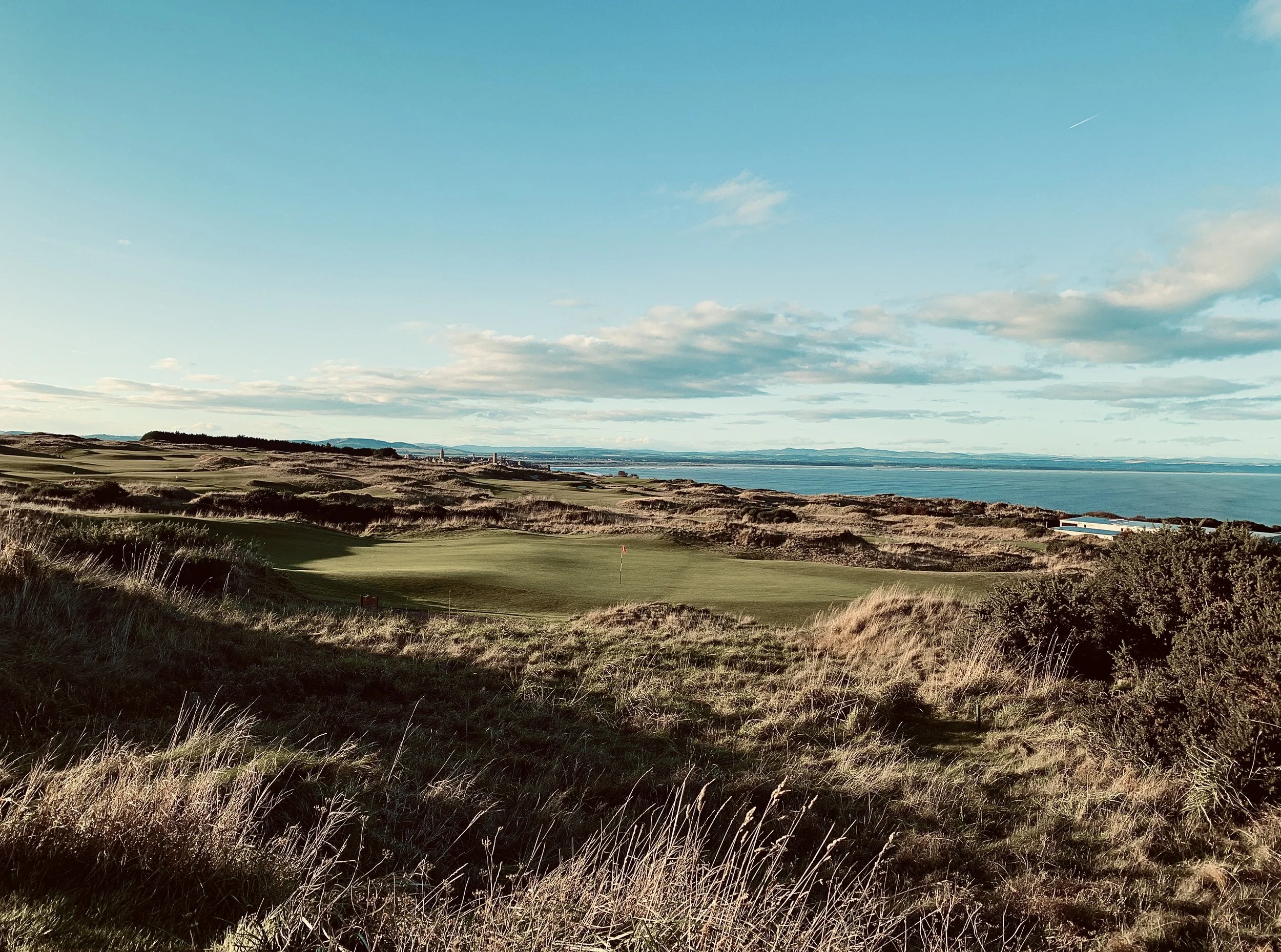
I spend countless conversations defending the seventh course at St Andrews. And I am more than willing to do so. Most people who play it once leave the never-ending driveway feeling bruised, bewildered, and a little embarrassed. I understand why. The Castle Course does not flatter first-timers. It demands something from you: attention, imagination, nerve, and it offers no apology for doing so.
But I’ve seen it more than three hundred times, in every weather pattern the East Neuk can conjure, with every type of golfer, from sunrise tee times to the last loop of the day. Three seasons caddying here became three of the most enjoyable summers I could ask for. And the more I walked it, the more I understood a simple truth: the Castle Course rewards familiarity. What looks excessive reveals itself as intentional. It is not a course you flirt with; it is a course you learn.
David McLay Kidd designed the Castle Course in 2008, turning former farmland into a clifftop links that looks, at times, almost too dramatic to be real. But beneath the surface spectacle is a designer who knows exactly what he’s doing. Kidd’s courses often feature width, movement, and strategic options that encourage golfers to think. Here, he weaves all that modernism into a landscape where cliffs, wind, and sky do half the work. There’s a reason it feels different from the rest of the St Andrews Links family: it is different. And that difference is the whole point.
Upon arrival at the Castle, you are greeted by an understated and peculiarly circular clubhouse. This is the first indication that we are not in Tom Morris land anymore. The walk up to the first tee is your first exposure to the elements, up a small rise and across a putting green that quietly merges into the teeing ground. No edges, no boundaries, just a smooth flow that mirrors the town below, where you can stumble from Old to Eden without noticing much change underfoot. The contours of the practice greens are so aggressive that they become oddly comforting. “Are they all like this?” is the line I hear more than any other.
The first hole is gentle. Just over three-hundred and not an awful lot of undulation. A driver in a westerly, a long iron for the confidence-seekers. Miss it fifty yards either side, and you’ll still have a playable approach. The green is calm, lulling you into false security before the course bares its teeth on the second. A simple paragraph here builds optimism. Enjoy it.
Number two is what I regard as the hardest hole on the course. For longer hitters, the landing area is tightly guarded by deep bunkers. Shorter hitters' drives are swallowed by the valley leaning right, leaving a long, sometimes blind shot to the green. A miss right of this green is dead. The room is on the left; however, the lack of visibility from the fairway pushes you the other way. The green itself makes you sea sick just by reading your putt. The huge false front can be traumatic for those short-sided to a front pin.
The third hole is your first taste of the views. A long iron off the tee while staring at St Andrews and the sweep of the bay. The green feels rotated ninety degrees, with a huge slope from left to right. If you stay on the correct ledge, birdie is in play. If not, welcome to lag-putt purgatory.
The next two par fives are where scorecards breathe again. Four is reachable with the common wind; five is long but straightforward if you plot properly. The fourth green is often the moment golfers close their card, surrender to the contours, and start enjoying the ride instead of fighting it.
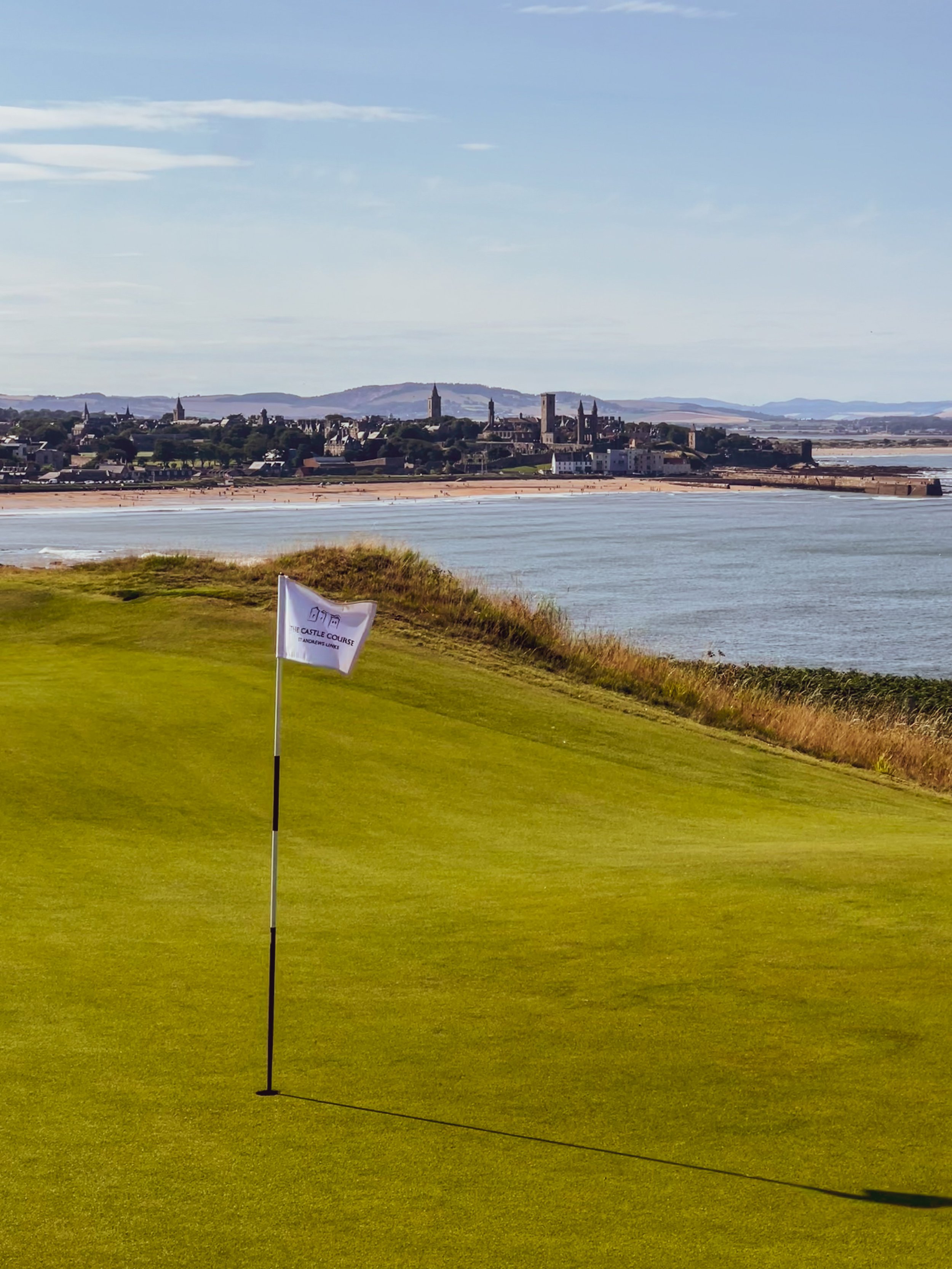
Most golfers waste their photos on the sixth tee instead of the green. A simple drive left of the marker, and suddenly, the entire town opens up in front of you. Wind surfers on the East Sands, the silhouette of St Andrews across the bay, it’s a moment that distracts even the most focused players. The hole itself is forgiving, though tall trees guard the wind on the approach. No one remembers how they putted here; the scenery steals that memory.
I find that seven, eight, and nine often feel like one ongoing hole. A par four, three, then four, all playing downhill. With the right wind, these three can go by quickly. Keep it right all the way home. But the red stakes left do mean that provisionals are not required for those already feeling beaten up.
The halfway house comes at the perfect time. Get the steak and black pudding pie and move on. Enough said there.
The long walk up to the tenth is a brief warm-up for the upcoming thousand-yard slog. The tenth green is its biggest defence. Everything is pin-dependent here. Back of the green to a front pin is impossible, and vice versa. A fade off the flag tends to be the play here. The backstop normally helps most out.
I don’t think that there is a poorly designed hole in the Castle, but Eleven comes close. There is no good club off this tee. As little as a 3-wood can get one into bunker trouble, yet a 3-iron leaves another one in to the green. Regardless, the key is the approach. Right is dead, left is your friend. The further left the better, and let the slopes help you out.
Then comes twelve, the heavyweight. I’ve seen it birdied maybe ten times in over a thousand rounds. Blind tee shot, guarded landing areas, and a green perched like a tabletop on a cliff. The wind can add invisible stimp. Kidd absolutely nailed this hole. The bunkering, the angles, the demand for precision. And the view from the green is the best on the course; cameras never quite capture it.
Thirteen and fourteen are gentle, but both somehow encourage a fade while simultaneously punishing it. Thirteen slopes left to right; anything right of the bunker is safe, but the sand to the right of the flag is evil. Fourteen is bunkerless but deceptive; the line to the right is tempting, but the left side is smarter. The green is chaos; take your three-putt and move on.
Fifteen and Sixteen feel like a typical flow of St. Andrews Links. Straight down the hill and out into the corner of the course. Fifteen, I think, is very well designed by Kidd. He’s forced even big hitters to lay up to this par five. Unless you have a full wedge in hand, the ball does not stop on this tiny green. As tempting as it is to hit a five or four iron in here with your second, the burn catches those short and the deep rough long tempts you away from the aggression. Good hole.
Seventeen is the signature, and an objectively beautiful golf hole. For first-time players, straight at the pin is daunting. However, going left is the play no matter how far you can carry the ball. Anywhere right of the bunker leads to the middle of the green. This is truly one of the most picturesque golf holes in the country and often does not get spoken about enough. Playing over the pro-v infested beach, hitting towards the town, and watching your ball take its penultimate Castle twist and turn on its way to the hole.
The final hole is a beast. A long par five that dog legs like a roundabout. Kidd has crafted an incredible finish here. This hole is playable for all abilities. In fact, the shorter you hit your drive, the easier it is to plot. Anything two-fifty and up forces you to hit into what becomes a horizontal fairway. However, if you carry the cliffs, you could be left with a mid-iron in. For those who are three-shotting this one, the huge bunker in the middle of the fairway encourages a left-side lay-up. I think this bunker would be well-positioned if it were earlier on in the round, however I often have seen golfers get stuck in here after being punched in the face by every other hole, and it can sometimes be the icing on the cake for Castle-haters. The green is tough. Guarded by bunkers and even more guarded by undulations, the complex of this ‘infinity’ green invites a lot of three putts. Supposedly, this is where Kinkell Castle once stood in the 1700s. The Americans love the old: “This is where the Castle used to be, but the greenkeepers moved it when it started getting in the way of the flag.” One last chuckle before heading into the clubhouse to recover.
Look, the Castle Course isn’t perfect, and it certainly does not fit in with the St Andrews Links feel in the rest of the town, but it does have its place. It isn’t supposed to be an ancient links; it isn’t supposed to fit in. The Castle Course often feels like its own entity, despite being under the Links’ name. From what used to be potato fields, Kidd did an unbelievable job here. Every mound, swale, and swallow on this course was handcrafted with an intention in mind. The man-made-ness is noticeable throughout the round, but somehow Kidd managed to marry the modernity of construction with the existing Fife landscape. He uses the cliffside as the hazard on six holes. He weaves and winds up the sloping landscape in a route that subtly makes golfers feel like they’ve summited a mountain without having to hit a drive up one.
Some golfers don’t like it. But the ones who return, the ones who come to understand it, appreciate the balance between ambition and restraint, drama and strategy, spectacle and subtlety. The Castle Course doesn’t want to be loved instantly. It wants to earn your respect slowly.
And when it does, it holds onto it.